Growing Word Knowledge through Morphology Trees
Growing Word Knowledge through Morphology Trees
Understanding how words are built helps students strengthen vocabulary, spelling, and reading comprehension. Morphology, or the study of meaningful word parts, is essential for unlocking meaning, spelling, and ultimately comprehension. Morphology trees provide a visual way for students to explore words that share a common base or root and discover how meaningful word parts contribute to overall word meaning.
How to Use a Morphology Tree Alongside a Word Matrix
A Morphology Tree works well alongside a Word Matrix to deepen students’ understanding of how words are built and how their meanings are connected.
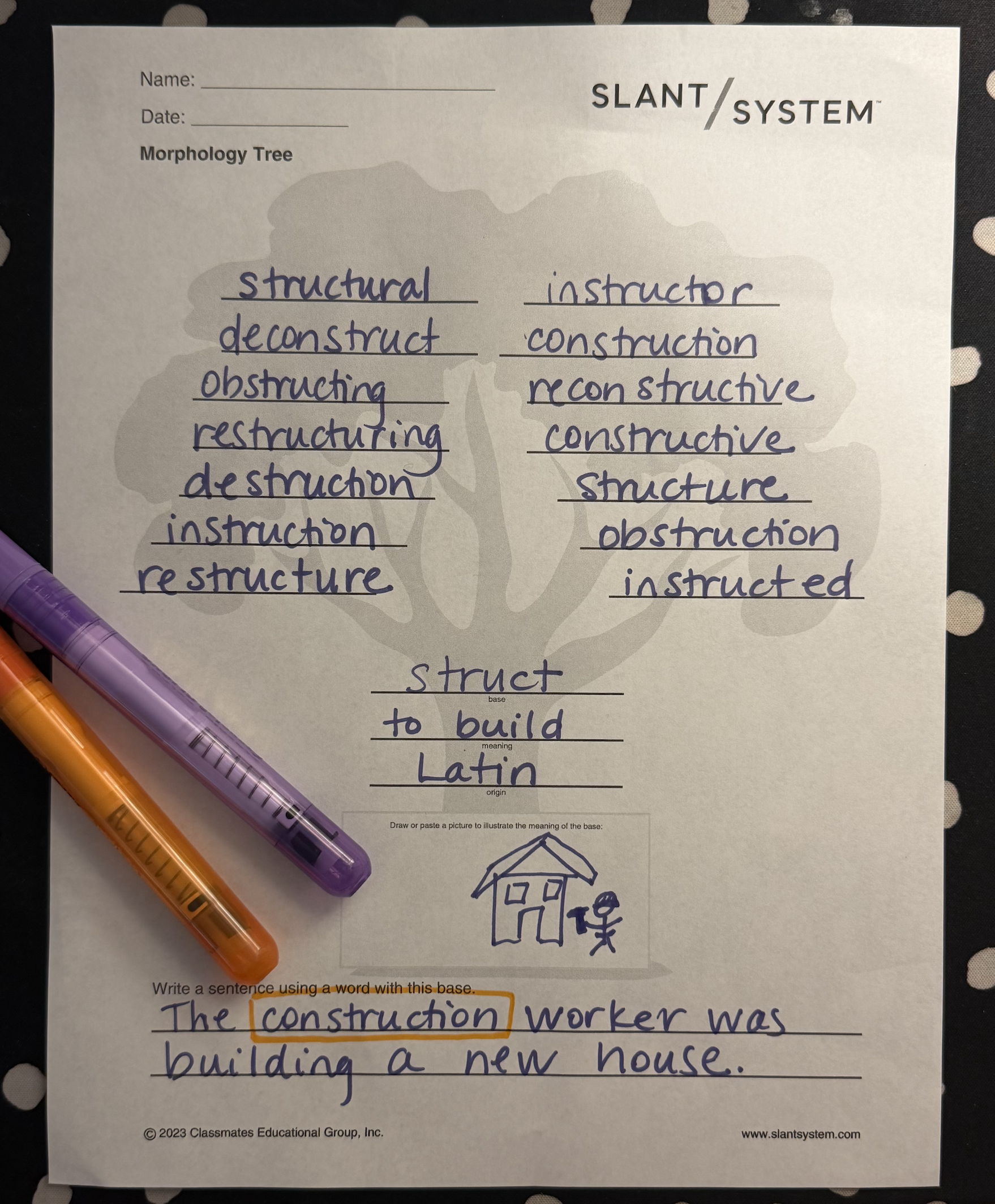
Begin with a base or root, its meaning, and its language of origin. Using a Word Matrix, students can combine the base with different prefixes and suffixes to build words. Once they have generated words, they can add them to the Morphology Tree, showing how each word connects to the shared meaningful base.

For example, students might use the Latin base struct, meaning “to build,” to explore words such as construct, reconstruct, destruction, and instructor. As students add words to the tree, discuss how the base contributes to each word’s meaning and how adding or changing morphemes changes that meaning.

Together, these tools help students move beyond building words to understanding the relationships among their meanings, strengthening morphological awareness, vocabulary, spelling, and reading comprehension (Carlisle, 2000; Bowers et al., 2010; Goodwin & Ahn, 2013).
Why Are Morphology Trees Beneficial?
Morphology trees help students move beyond memorizing individual words to recognizing meaningful patterns across words. This is especially useful with Greek and Latin bases, which appear in many multisyllabic and academic words. Research suggests that explicit morphology instruction can support students’ literacy development, including vocabulary, spelling, and reading comprehension (Carlisle, 2000; Bowers et al., 2010; Goodwin & Ahn, 2013).
For students who struggle with reading, understanding meaningful word parts offers another strategy for approaching unfamiliar words. Rather than treating each word as something new to memorize, students can draw on what they already know about its parts.
The goal is not simply to build a tree full of words. It is to help students understand how words work. By exploring the relationships among word parts, spelling, and meaning, students develop tools they can apply across reading, writing, and content-area learning.
Classroom Activities to Build Word Knowledge
Morphology trees become even more valuable when students use them to revisit words, make connections, and apply what they learn. Here are several ways teachers can incorporate them into literacy instruction.
1. Create a Personal Word Collection
Have students build a morphology folder or binder to collect their completed trees and the words they have learned. Each entry can include the base or root, its meaning and origin, related words, and student-friendly definitions or example sentences.
Encourage students to revisit their collections during vocabulary review, spelling activities, writing assignments, and content-area reading. Over time, this becomes a reference tool students can use when they encounter unfamiliar words.
2. Play Word Detective
Give students a word they encounter in a text and ask them to investigate its meaningful parts. Can they identify a familiar base or root? Do they recognize a prefix or suffix? What clues do those parts provide about the word’s meaning?
Students can add the word to an existing tree or begin a new one. If they are unsure of its meaning or structure, use an online dictionary or other reliable reference to confirm their thinking.
3. Compare Words and Their Meanings
Ask students to compare words on the same tree. How does the meaning change when a prefix or suffix is added? What meaning remains connected to the shared base?
For example, students can compare construct and reconstruct. Both relate to building, but reconstruct means to build again. Discussing these relationships helps students connect word structure with meaning rather than simply memorizing definitions.
4. Use Words in Speaking and Writing
After building a tree, have students select two or three related words to use in original sentences. Encourage them to explain how each word’s meaning fits its context.
Students can also revise a sentence by replacing a familiar word with a related word from the tree. Discuss how the word choice changes the meaning or precision of the sentence. This helps students apply their morphological knowledge beyond the word-building activity.
5. Revisit and Grow Existing Trees
A morphology tree does not have to be completed in one lesson. When students encounter another word related to a previously studied base, invite them to add it to their existing tree.
Use these additions as opportunities for cumulative review. Ask students to explain the connection between the new word and the base, identify its meaningful parts, and describe how its meaning relates to other words on the tree.
This ongoing practice helps students strengthen and retrieve their knowledge over time.

References
Bowers, P. N., Kirby, J. R., & Deacon, S. H. (2010). The effects of morphological instruction on literacy skills: A systematic review of the literature. Review of Educational Research, 80(2), 144–179. https://doi.org/10.3102/0034654310377087
Carlisle, J. F. (2000). Awareness of the structure and meaning of morphologically complex words: Impact on reading. Reading and Writing, 12, 169–190.
Goodwin, A. P., & Ahn, S. (2013). A meta-analysis of morphological interventions in English: Effects on literacy outcomes for school-age children. Scientific Studies of Reading, 17(4), 257–285. https://doi.org/10.1080/10888438.2012.689791