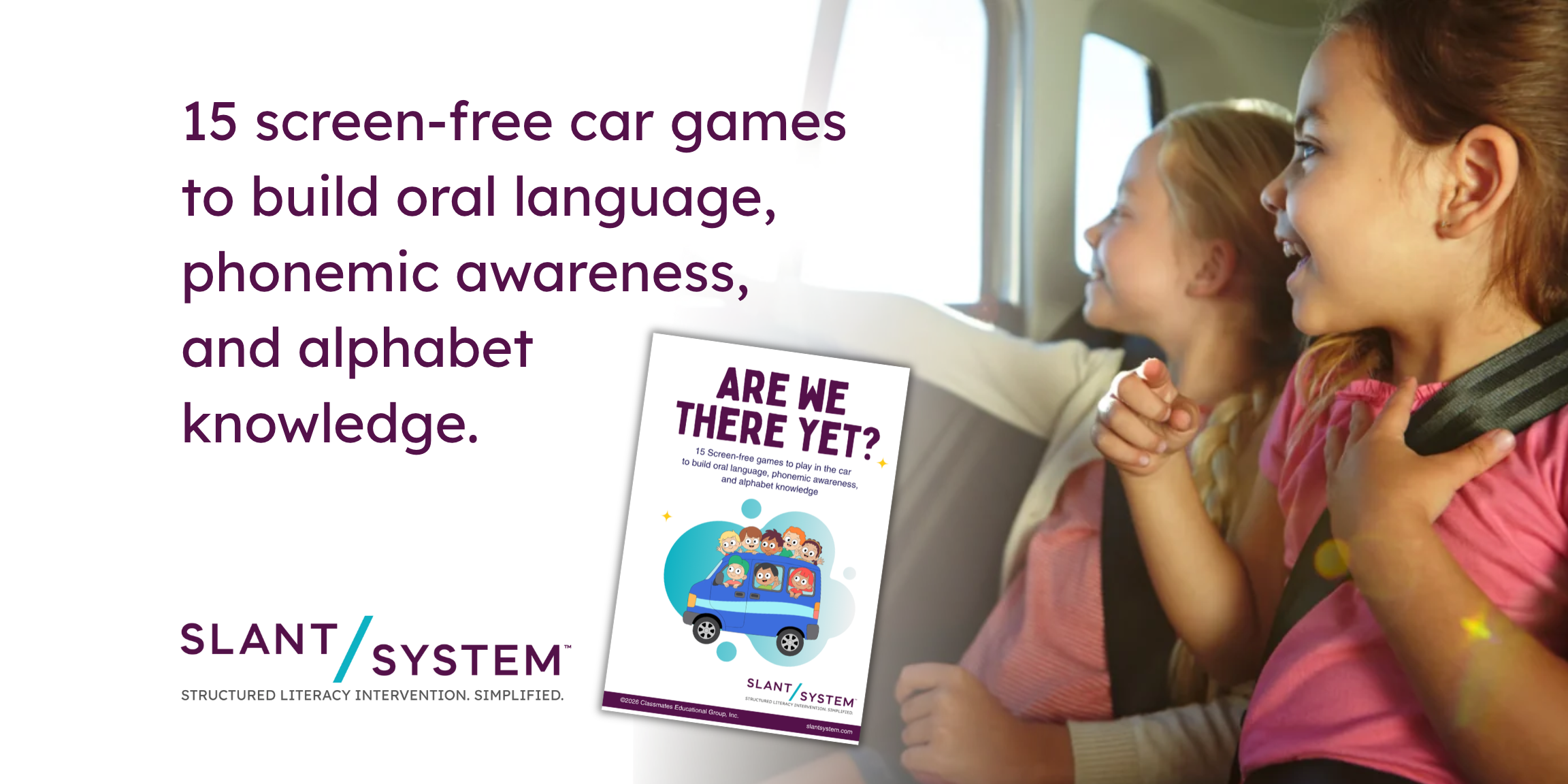
No Screens Required: Literacy Games for the Road
No Screens Required: Literacy Games for the Road
Turn everyday car rides into opportunities to build the foundational skills that support reading.
How many times have you heard, “Are we there yet?” from the back seat?
The next time you are heading to school, running errands, or taking a family road trip, consider turning that time into an opportunity for playful learning. You do not need a tablet, a workbook, or even a book. You just need a little imagination and a willingness to play with words.
For emergent readers, everyday experiences can provide meaningful opportunities to develop oral language, phonemic awareness, and alphabet knowledge. These foundational skills help children understand how language works and prepare them for the process of learning to read.
And the best part? Many of these games can be played entirely through conversation.
Why Play Matters for Early Literacy
Learning to read involves much more than recognizing letters on a page. Children need to understand language, recognize the sounds within spoken words, and connect those sounds to letters.
Three important areas of early literacy development include:
Oral language: Children develop vocabulary, listening comprehension, expressive language, and the ability to describe and explain their ideas. These skills support reading comprehension as children begin to read independently.
Phonemic awareness: Children learn to recognize and manipulate the individual sounds in spoken words. They begin to hear that words are made up of sounds that can be blended, separated, and changed.
Alphabet knowledge: Children learn to recognize letters and understand that letters represent sounds. This knowledge is an important foundation for decoding and spelling.
Research has consistently demonstrated the importance of these foundational skills. Phonemic awareness and letter knowledge are strong predictors of early reading success, while oral language supports the development of reading comprehension (National Early Literacy Panel, 2008; National Reading Panel, 2000).
The good news is that children can practice these skills during everyday activities, including a simple car ride.

15 Screen-Free Literacy Games for the Car
Alphabet Knowledge and Environmental Print
These games help children recognize letters, connect letters to sounds, and notice the print that surrounds them.
1. The Alphabet Game
This is a family favorite!
Start with the letter A and work your way through the alphabet. Look for words on signs, billboards, buildings, and vehicles that begin with each letter. When someone finds a word, they identify the letter, say its sound, and read the word if they can.
For example:
- A: Auto (Auto Zone)
- B: Burger (Burger King)
- C: Corvette
The goal is to move through the alphabet in order. If you cannot find a word for a particular letter, keep looking!
For children who are just beginning to learn their letters, parents can identify the letter and say its sound together with the child. As children develop their reading skills, encourage them to read the entire word.
2. License Plate Letter Hunt
Look at the letters on license plates. Can your child find a particular letter? Can they tell you the sound it represents?
For a challenge, ask them to give you some words that begin with the letter-sound you are finding.
3. Find the Word!
Choose a familiar word such as STOP, EXIT, or SPEED (on speed limit signs).
See how many times your child can find the word during the ride. Talk about the letters, sounds, and meaning.
This is a wonderful opportunity to help children understand that print communicates meaning.
4. Letter-Sound Hunt
Choose a letter-sound.
Everyone takes turns finding and object that begins with that letter. Children can name the object, identify the beginning sound, and describe it.
For example, if the letter is T, children might find a truck, a tree, or a traffic sign. As a challenge, children can find something that has the letter-sound anywhere in it’s name. For example, if the letter-sound is /t/ for T, they can find “Target” or “Wal-Mart” since the /t/ sound is in both of those names.
Phonemic Awareness Games
Phonemic awareness is the ability to hear and work with individual sounds in spoken words. These games are especially helpful because children do not need to see letters to play.
5. I Spy a Sound
Instead of saying, “I spy something green,” say, “I spy something that starts with /b/.”
Children listen for the sound and guess the object.
For example, /b/ might be a bus, building, or billboard.
Remember to say the sound itself rather than the letter name. For /b/, say the short sound, not “bee.”
6. Guess My Word
Say a word slowly, stretching out each sound. Children blend the sounds together to figure out the word.
For example:
/m/ /a/ /p/
“What word am I saying?”
MAP!
Start with simple two- and three-sound words. As children become more skilled, try longer words.
7. Sound Stretch
Pick a word and ask your child to stretch it out like a rubber band, saying each sound slowly.
For example:
SUN = /s/ /u/ /n/
Ask, “How many sounds do you hear in sun?”
Children can count on their fingers or tap each sound.
8. Rhyme Time
Say a word and take turns thinking of words that rhyme.
For example:
CAT, HAT, MAT, SAT.
For an extra challenge, make up silly rhyming words. The goal is to hear and recognize the sound patterns, not necessarily to produce real words.
9. Sound Switch
Say a word and ask your child to change one sound to make a new word.
For example:
“Say cat. Now change /c/ to /h/. What word do you get?”
HAT!
Begin with simple words and demonstrate as needed. As children become more comfortable, try changing the ending sound or middle vowel.
10. How Many Sounds?
Say a word and ask your child to count the individual sounds they hear.
For example:
FISH has three sounds: /f/ /i/ /sh/.
Children can count on their fingers or tap each sound.
This is a great way to help children understand that the number of sounds in a word is not always the same as the number of letters.
Oral Language and Vocabulary Games
Oral language builds the vocabulary, background knowledge, and sentence skills children need to understand what they read. These games encourage children to think, explain, describe, and use language.
11. Would You Rather?
Ask questions that encourage children to explain their thinking.
For example:
“Would you rather live in a house in the mountains or a house by the ocean? Why?”
Encourage complete sentences and follow-up questions.
Instead of accepting a one-word answer, ask, “Can you tell me more about that?”
12. Describe It!
Choose something you see outside. Describe it without naming it. Your child guesses what it is.
For example:
“It is large, has four wheels, and carries things from one place to another.”
A truck!
For a challenge, let your child describe something for you to guess.
13. The Story Continues
Start a story with one sentence. Each person adds another sentence.
For example:
“One day, a little dog got into a big red truck…”
The next person might say:
“He was on his way to visit his grandmother.”
Encourage children to use descriptive words, connect their ideas, and keep the story going.
14. Name That Category
Choose a category and take turns naming things that belong.
Examples include:
- Animals
- Foods
- Things that fly
- Things that are round
- Things you find in a kitchen
For a challenge, ask children to explain why an item belongs in the category.
15. Tell Me More!
When your child notices something outside, use it as an opportunity to build language.
For example:
Child: “I see a big truck!”
Parent: “What do you think it is carrying? Where do you think it is going? What might happen if it gets stuck?”
These open-ended questions encourage children to use vocabulary, make predictions, and explain their thinking.
Making the Games Developmentally Appropriate
The same game can be adjusted depending on where a child is in their literacy development.
For children who are just beginning to learn their letters, focus on letter names, beginning sounds, rhyming, vocabulary, and listening.
For children beginning to decode, add sound blending, sound segmentation, and familiar environmental words.
For beginning readers, encourage them to read words they see on signs and identify the sounds within those words.
The goal is not to turn every car ride into a lesson. It is to make language and reading a natural part of everyday life.
A Little Play Goes a Long Way
Children do not need a screen to engage in meaningful learning. Sometimes the most valuable learning experiences happen through simple conversations, playful challenges, and the words we encounter in our everyday surroundings.
A few minutes of playing with sounds, letters, and words can help children develop the skills they need as they begin their reading journey.
So the next time you hear, “Are we there yet?” you might respond with:
“Let’s play a word game!”
What are your family’s favorite screen-free games to play in the car? Share your ideas with us. We would love to hear how you are making literacy a part of everyday life.
References
National Early Literacy Panel. (2008). Developing early literacy: Report of the National Early Literacy Panel. National Institute for Literacy.
National Reading Panel. (2000). Teaching children to read: An evidence-based assessment of the scientific research literature on reading and its implications for reading instruction. National Institute of Child Health and Human Development.