Engaging the Reading Brain Through Word Study – Morpheme Breakdown
Engaging the Reading Brain Through Word Study
Have you ever worked with a student who can read a word accurately but cannot explain what it means? Or a student who struggles to read a longer word because it feels like one overwhelming string of letters?
These moments remind us that reading is about more than recognizing words. Students need to understand how words are constructed, how their spelling represents their pronunciation, and how meaningful word parts contribute to vocabulary and comprehension.
That is why explicit word study is so important.
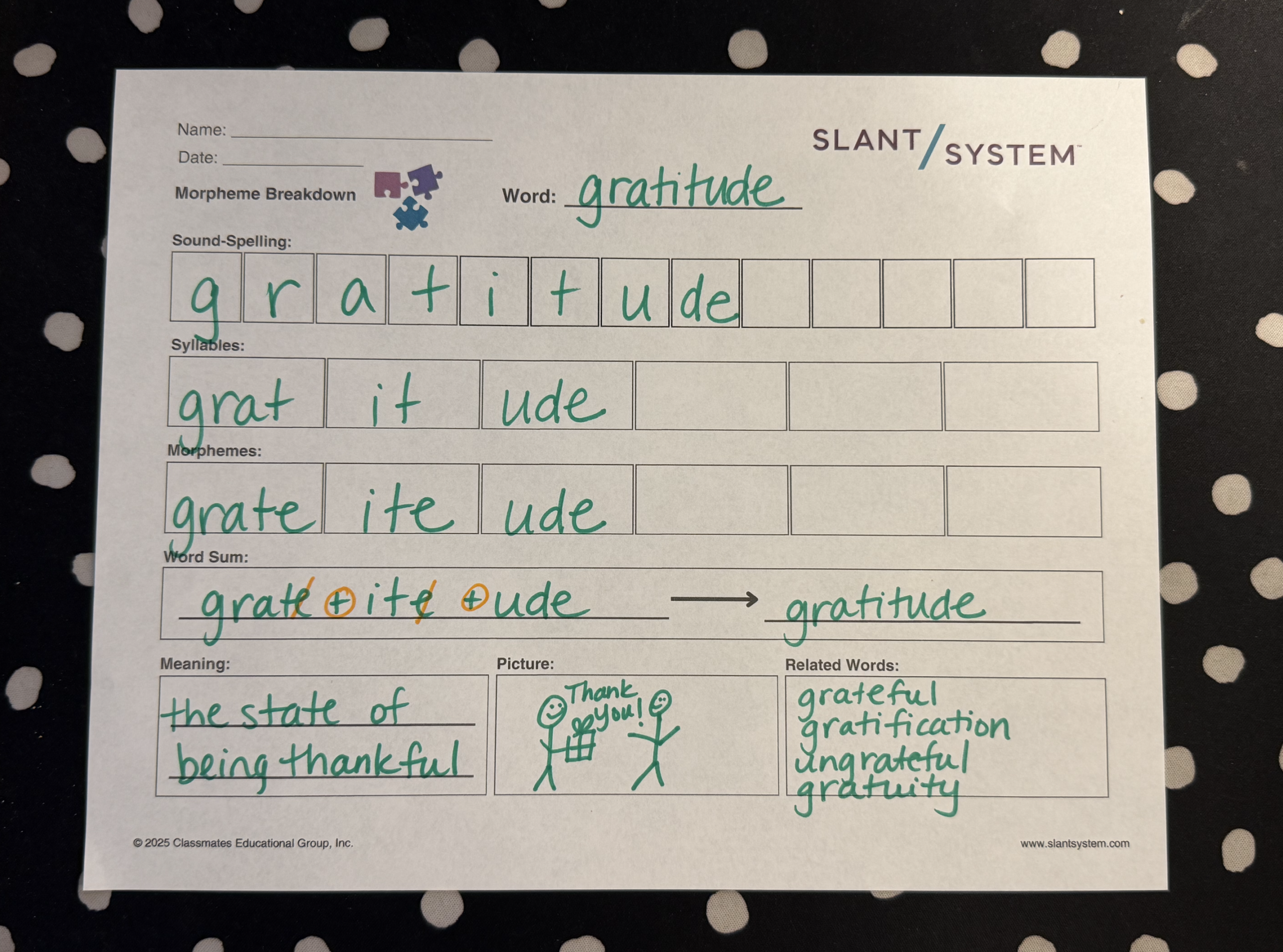
The Slant System™ Morpheme Breakdown tool gives students a structured way to investigate words. Instead of simply asking students to read a word, we invite them to examine it from multiple perspectives: sound-spelling relationships, syllables, morphemes, word sums, meaning, visual representation, and related words.
Each component serves a purpose. Together, they help students build connections among the language systems that support reading, spelling, and comprehension.
Reading Is a Brain-Based Process
When we teach students to read, we are helping them develop and coordinate networks in the brain that support language and literacy.
Reading involves the integration of phonological processing, orthographic knowledge, meaning, and language comprehension. These processes are supported by interconnected regions of the brain, particularly networks involving the left frontal, temporal, and parietal regions (Dehaene, 2009; Marks et al., 2022).
Research on morphological awareness has shown that children who demonstrate stronger reading comprehension engage brain regions associated with integrating sounds, meanings, and language structures. These findings suggest that morphology plays an important role in the development of the reading brain (Marks et al., 2022).
A 2024 longitudinal study also found that brain activation during an auditory morphological awareness task was associated with children’s reading development 1.5 years later. Greater activation in superior temporal regions involved in word segmentation was associated with stronger reading outcomes and greater reading gains over time (Marks et al., 2024).
This does not mean that completing a worksheet strengthens one specific brain region. Rather, explicit word study provides opportunities for students to practice coordinating the language processes that support skilled reading.
Let’s take a closer look at how each component of the Morpheme Breakdown tool contributes to this process.

1. Sound-Spelling: Connecting Sounds to Print
The first component asks students to examine the sound-spelling relationships within a word.
Students identify the phonemes they hear and the graphemes that represent those phonemes. This requires them to attend to the individual sounds in a word and connect those sounds to written symbols.
Why is this important?
Students need to understand the alphabetic principle: written letters and letter combinations represent the sounds in spoken language. When students develop strong connections between phonemes and graphemes, they are better equipped to decode unfamiliar words and spell words accurately.
This process also supports orthographic mapping, the process through which spellings become connected to pronunciations and meanings in memory. Orthographic mapping allows readers to recognize familiar words automatically rather than having to decode them each time they encounter them (Ehri, 2014).
2. Syllables: Organizing Longer Words
The syllable component gives students an opportunity to examine how a word can be divided into pronounceable units.
For students who struggle with longer words, this can make an unfamiliar word feel more manageable. Instead of approaching a word as one long sequence of letters, students can identify syllables and use their knowledge of syllable patterns to support decoding.
For example, a student working with the word fantastic might identify three syllables:
fan | tas | tic
This process supports the development of strategies for reading multisyllabic words. It also gives students an opportunity to compare syllable divisions with the sound-spelling relationships they have already identified.
3. Morphemes: Discovering Meaningful Word Parts
This is where word study becomes especially powerful.
A morpheme is the smallest meaningful unit of language. Morphemes include bases, prefixes, and suffixes. Some morphemes can stand alone as words, while others must be combined with another morpheme.
When students identify morphemes, they begin to see that words are not simply collections of letters. They are meaningful units that can be combined in predictable ways.
Consider the word unhelpful:
- un- means not
- help is the base
- -ful means full of
Students can use these meaningful parts to understand the word, even if they have never encountered it before.
Morphological awareness supports word reading, spelling, and comprehension because morphemes provide information about a word’s structure, pronunciation, and meaning (Kirby & Bowers, 2017).
Research has also demonstrated that morphological awareness contributes to reading comprehension beyond the contributions of vocabulary knowledge and decoding ability (Marks et al., 2022).
4. Word Sum: Making Word Structure Visible
Once students have identified the morphemes, they can use a word sum to show how those meaningful parts combine to form a word.
For example:
help + ful → helpful
un + help + ful → unhelpful
The word sum makes the relationship between the individual morphemes and the complete word visible.
It also reinforces the understanding that word structure is meaningful and that spelling often reflects this structure.
For example, students can examine the word action:
act + ion → action
The word sum helps students understand why the spelling contains the letter t, even though the pronunciation of the word includes the /sh/ sound. The spelling reflects the meaningful relationship between act and action.
This is an important opportunity to connect morphology, phonology, and orthography.
A 2024 meta-analysis examining 103 studies found that morphological assessments involving spelling were more predictive of both word reading and reading comprehension than assessments that did not examine spelling accuracy (Goodwin et al., 2024).
5. Meaning: Connecting Word Structure to Vocabulary
Identifying morphemes is only part of the process. Students also need to understand how those morphemes contribute to the meaning of the complete word.
The meaning component gives students an opportunity to explain a word in their own words.
For example, when studying unhelpful, students might explain:
Something that is not helpful or does not provide assistance.
This step is important because students can accurately decode a word without understanding it. Reading comprehension requires readers to connect the words they recognize with the meanings they know.
Morphological analysis provides a strategy for understanding unfamiliar vocabulary. When students understand the meaning of a base and the function of an affix, they can use that knowledge to make sense of new words.
In a study of fourth- and fifth-grade students, morphological instruction improved students’ morphological analysis and vocabulary knowledge, including their ability to learn novel words built from previously taught bases (Bowers & Kirby, 2010).
6. Picture: Creating a Visual Representation
The picture component invites students to represent the meaning of the word visually.
This may seem like a simple addition, but it provides another opportunity for students to demonstrate their understanding.
When students draw a representation of a word, they must consider what the word means and how that meaning can be expressed visually.
For example, a student studying unhelpful might draw a person attempting to solve a problem without receiving assistance.
The picture is not intended to replace explicit vocabulary instruction. Instead, it gives students another way to represent and communicate the meaning they have learned.
7. Related Words: Building Morphological Families
The final component asks students to identify related words.
This is an opportunity to extend learning beyond the original word and help students recognize patterns across a family of words.
For example, students studying helpful might identify:
- help
- helper
- helping
- helpless
- unhelpful
These words share the base help, which provides a meaningful connection among them.
Recognizing morphological families can help students build vocabulary, recognize familiar spelling patterns, and use their knowledge of known words when encountering unfamiliar words.
Morphological knowledge is particularly valuable as students move into more advanced academic reading, where complex words become increasingly common (Nagy & Townsend, 2012).

Bringing It All Together
The Morpheme Breakdown tool is designed to help students investigate words systematically. Each component provides an opportunity to examine a different aspect of the word:
These components are not intended to be isolated activities. Their power comes from the connections students make across them. Morphological instruction has been shown to benefit literacy development, including spelling, vocabulary, reading, and morphological awareness. Research also suggests that morphology instruction is particularly effective when it is integrated with other aspects of literacy instruction rather than taught in isolation (Bowers et al., 2010).
When students examine the sounds, spelling, syllables, meaningful parts, and meaning of a word, they are doing more than completing a worksheet. They are developing a deeper understanding of how written language works. And that understanding gives them a strategy they can carry into the next unfamiliar word, the next challenging text, and the next opportunity to grow as a reader.
References
Bowers, P. N., & Kirby, J. R. (2010). Effects of morphological instruction on vocabulary acquisition. Reading and Writing, 23, 515–537. https://doi.org/10.1007/s11145-009-9172-z
Bowers, P. N., Kirby, J. R., & Deacon, S. H. (2010). The effects of morphological instruction on literacy skills: A systematic review of the literature. Review of Educational Research, 80(2), 229–251. https://doi.org/10.3102/0034654309359353
Ehri, L. C. (2014). Orthographic mapping in the acquisition of sight word reading, spelling memory, and vocabulary learning. Scientific Studies of Reading, 18(1), 5–21. https://doi.org/10.1080/10888438.2013.819356
Goodwin, A. P., et al. (2024). Morphological assessment features and their relations to reading: A meta-analytic structural equation modeling study. Educational Research Review, 43, 100602. https://doi.org/10.1016/j.edurev.2024.100602
Kirby, J. R., & Bowers, P. N. (2017). Morphological instruction and literacy: Binding phonological, orthographic, and semantic knowledge. In K. Cain, D. L. Compton, & R. K. Parrila (Eds.), Theories of reading development. John Benjamins.
Marks, R. A., Eggleston, R., & Kovelman, I. (2022). The neurocognitive basis of morphological processing in typical and impaired readers. Annals of Dyslexia, 72(2), 361–383. https://doi.org/10.1007/s11881-021-00239-9
Marks, R. A., Eggleston, R., & Kovelman, I. (2024). Brain bases of morphological awareness and longitudinal word reading outcomes. Journal of Experimental Child Psychology, 240, 105802. https://doi.org/10.1016/j.jecp.2023.105802
Nagy, W., & Townsend, D. (2012). Words as tools: Learning academic vocabulary as language acquisition. Reading Research Quarterly, 47(1), 91–108. https://doi.org/10.1002/RRQ.011