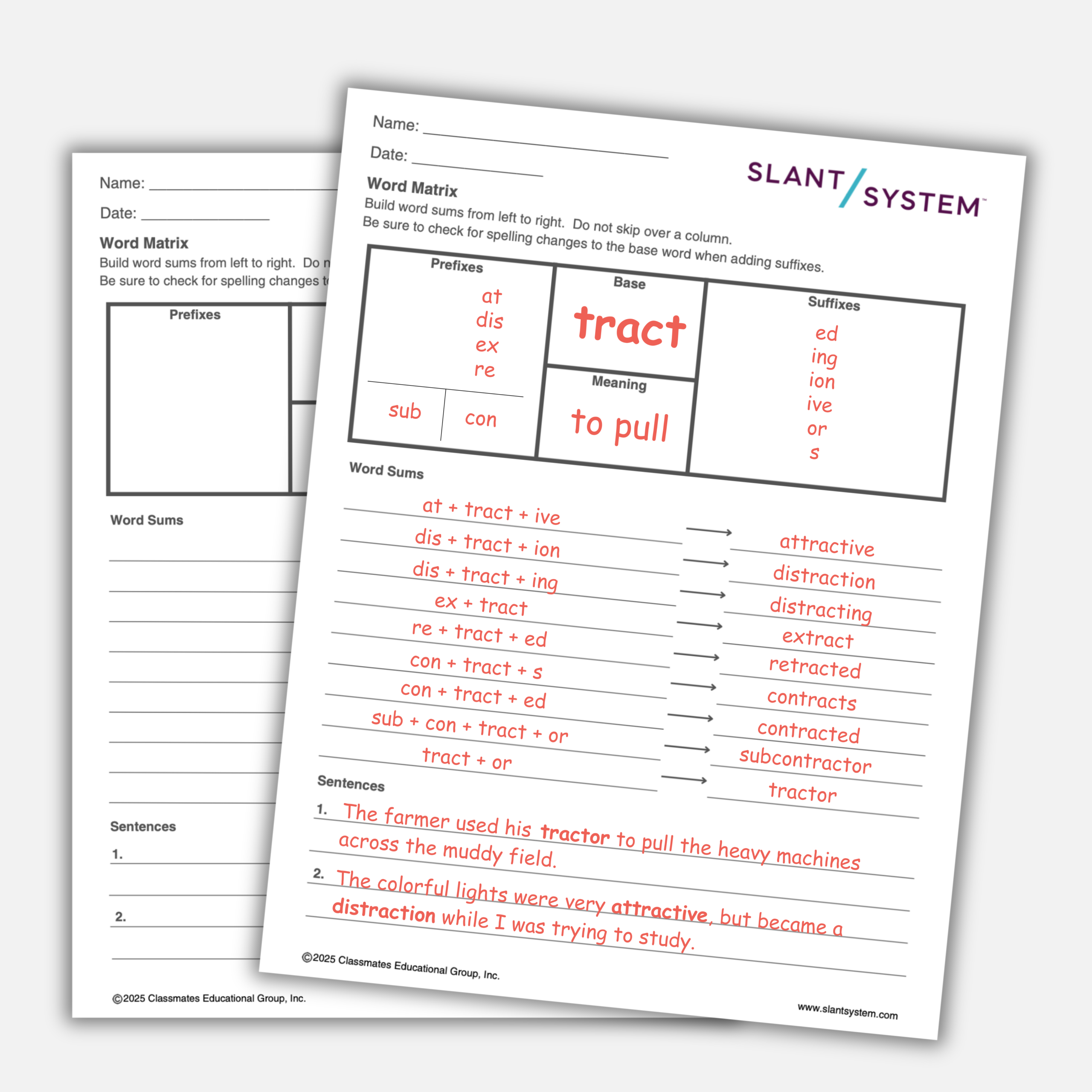
Free Word Matrix Practice Sheet for Morphology & Vocabulary
Unlock Vocabulary Growth with Our Free Word Matrix Practice Sheet!
Looking for an engaging, effective way to help your students master vocabulary and decoding? Morphology is key to unlocking reading comprehension, and our Free Word Matrix Practice Sheet makes it simple and interactive!
With this printable freebie, students will:
-
Build Word Sums: Learn how prefixes, root words (like tract, meaning “to pull”), and suffixes fit together to form complex words.
-
Strengthen Spelling & Meaning: See firsthand how changing prefixes or suffixes transforms a word’s meaning and usage.
-
Apply Context Clues: Practice creating sentences using newly formed words like attractive, distraction, and subcontractor.

Creating Word Sums: Connecting Meaning and Spelling
A word sum shows how a base or root combines with prefixes and suffixes to build a word. It makes the structure of a word visible and helps students connect its spelling, pronunciation, and meaning.
To create a word sum, students begin with a base and add one affix at a time, using a plus sign between each meaningful word part and an arrow to show the completed word.
For example:
help + ful → helpfulhelp + ful + ness → helpfulnesshap + y + ness → happiness
As students build words, they must pay attention to more than the meaning of each morpheme. Adding a suffix can change the spelling of the base or a previously added suffix. Students need to recognize when a spelling change is required and explain why it occurs.
Three Spelling Rules to Watch For
1. The 1+1+1 Doubling Rule
When a one-syllable base ends in one vowel followed by one consonant, double the final consonant before adding a vowel suffix, provided the base meets the rule’s conditions.
Examples:
hop + ing → hoppingbig + est → biggestrun + er → runner
2. The Y-to-I Rule
When a base ends in a consonant followed by y, change the y to i before adding most suffixes. Keep the y when adding -ing.
Examples:
hap + y + ness → happinesstry + ed → triedtry + ing → trying
3. The Silent E Rule
When a base ends in a silent e, drop the e before adding a vowel suffix, unless another spelling convention requires keeping it. The e is generally retained before a consonant suffix.
Examples:
make + ing → makinghope + ful → hopefulcare + less → careless
Remember: Spelling Changes Can Happen More Than Once
Students should continue checking spelling as they add each morpheme, including when adding a suffix to a word that already contains another suffix. For example, in struct + ure + al the spelling of the base does not change when -ure is added, however when adding on the final suffix, the e in –ure must be dropped so the final word is structural. Have students say each morpheme, explain its meaning, and identify any spelling changes as they build the word. This encourages them to think about how meaningful word parts work together while reinforcing the spelling conventions needed to read and spell increasingly complex words.