Connecting Speech to Print: A Hands-On Word Chaining Activity
Connecting Speech to Print: A Hands-On Word Chaining Activity
Helping students become confident readers and spellers starts with understanding how spoken words connect to written words. Students need opportunities to hear the individual sounds in words, connect those sounds to letters, and blend the letters back together to read the word.
Our Wipe-Off Blending Board gives parents and teachers a simple, hands-on way to practice these essential skills through an activity called word chaining. With a dry-erase marker and a set of words, students can practice segmenting sounds, spelling words, and discovering how changing just one sound creates a new word.
Research on word learning emphasizes the importance of connecting the sounds in spoken words to their written spellings. Linnea Ehri’s research on orthographic mapping explains how readers bond spellings to pronunciations and meanings in memory, supporting accurate word reading and spelling (Ehri, 2014, 2020). Word chaining provides an opportunity to practice these sound-spelling connections in an explicit, active way.
How to Use the Wipe-Off Blending Board
The activity is simple, but the learning is powerful. An adult dictates a word, and the student listens carefully, segments the word into its individual sounds, and writes the spelling for each sound in the boxes on the card. As the student writes, they say each sound aloud.
Once the word is complete, the adult dictates a new word that differs by just one sound. The student listens to the new word, identifies which sound has changed, and adjusts the spelling in the appropriate box.
After making the change, have the student blend the sounds together to read the new word.
This process encourages students to pay attention to the sounds in words and the letters that represent those sounds rather than relying on memorization or guessing. Research by Ehri and Boyer (2011) found that phoneme segmentation instruction involving letters supported children’s phoneme segmentation, spelling, and word-reading development. This supports the instructional value of helping students connect spoken sounds directly to written spellings.

Step-by-Step Instructions
- Say the word. The adult dictates a word, such as shop.
- Segment the sounds. The student says each sound in the word: /sh/ /ŏ/ /p/.
- Write and say the sounds. The student writes the spelling for each sound in a box while saying the sound aloud. For shop, the student writes sh | o | p.
- Blend and read. The student blends the sounds together to read shop.
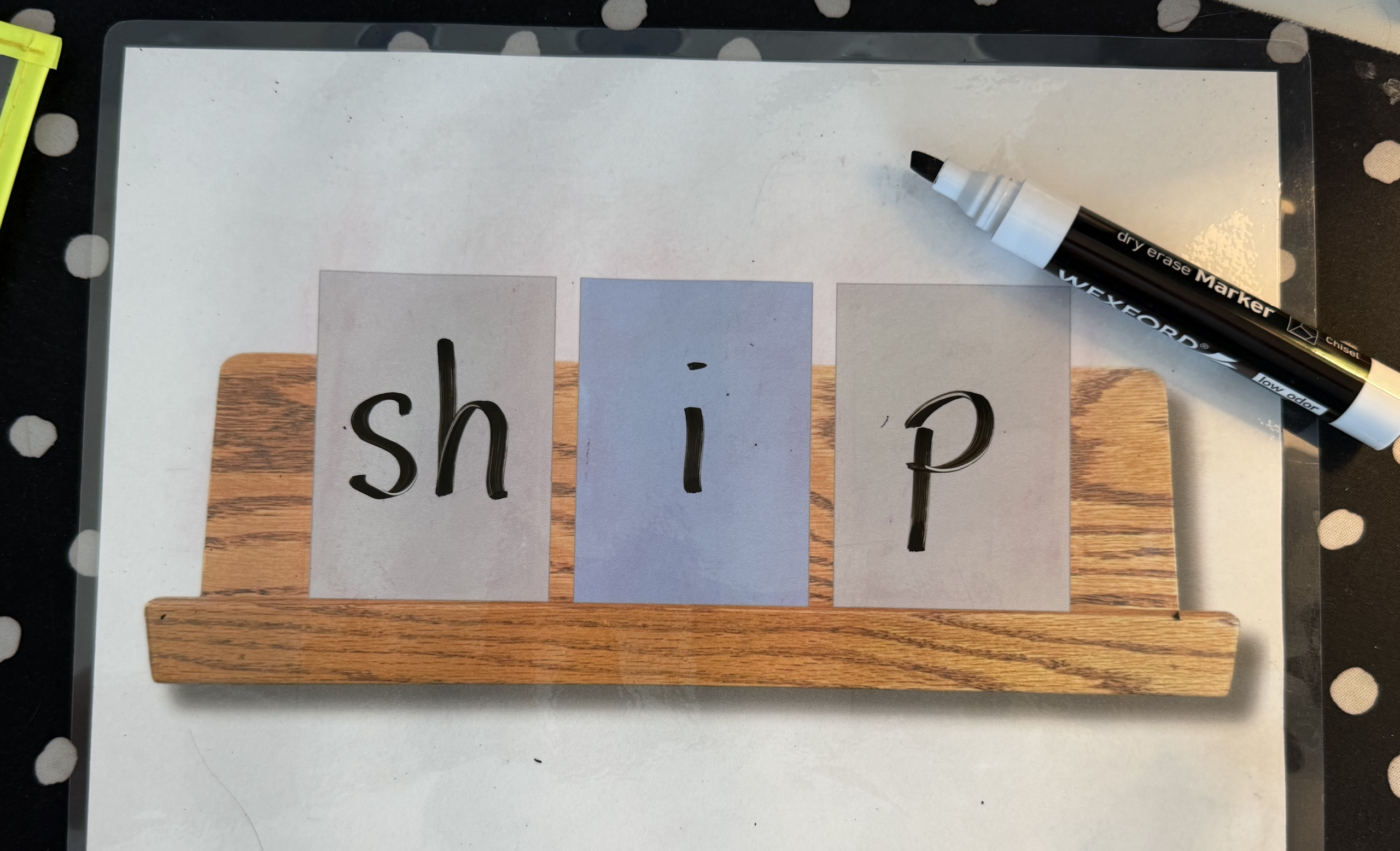
- Change one sound. The adult dictates the next word, such as ship. The student identifies the sound that changed and replaces the o with i.
- Blend and read. The student blends the sounds together to read ship.
- Continue the chain. The adult dictates another word, and the student makes the necessary change to create the new word.
The goal is for students to listen carefully, make the spelling change, and read each new word before moving on.
This routine reflects an important principle of structured literacy: students benefit from explicit opportunities to work with speech sounds and their corresponding spellings. As Louisa Moats explains, effective reading and spelling instruction requires knowledge of how spoken language is represented in print (Moats, 2020).
As students move through the chain, they must listen to the entire word, identify its individual sounds, and determine which spelling needs to change. Even though each new word differs by only one sound, students must attend to the sequence of sounds in the word and connect each sound to its written representation.
An important teaching tip: Ask students to read each word after making a change. This reinforces the connection between spelling and reading and gives you an opportunity to check whether the student can blend the word accurately.
Word chaining also provides an opportunity to observe how students apply their knowledge of the alphabetic principle. Can they identify the sound that changed? Can they represent that sound with the correct spelling? Can they blend the resulting word? These observations help adults identify where a student may need additional instruction or practice.
Why Does This Activity Matter?
Word chaining with our Wipe-Off Blending Board brings together several foundational skills that contribute to reading and spelling development.
Phonemic awareness: Students listen to spoken words and segment them into individual phonemes. They must recognize that words are made up of a sequence of sounds that can be identified and manipulated.
Sound-spelling connections: Students connect each phoneme to its corresponding grapheme. For example, the two letters s and h work together to represent the single phoneme /sh/. Ehri’s research identifies phonemic segmentation and knowledge of letter-sound relationships as important foundations for learning to read words (Ehri, 2020).
Encoding and decoding: When students write the dictated word, they are encoding sounds into written spellings. When they blend the sounds to read the word, they are decoding. Providing opportunities to connect these processes helps students apply their knowledge of the alphabetic writing system (Moats, 2020).
Attention to the structure of words: Changing one sound at a time encourages students to attend to the sequence of phonemes within words. Rather than memorizing each word as a whole, students practice applying sound-spelling knowledge to read and spell new words.
Tips for Parents and Teachers
Start with words your student can successfully decode. Choose words that use sound-spelling relationships the student has already learned. As students become more proficient, introduce more complex words and spelling patterns.
Keep the focus on sounds. Encourage students to say the individual sounds as they write the corresponding spellings. For example, in shop, the letters s and h work together to represent one sound, /sh/. The student should write sh in one box because the box represents a sound, not an individual letter.
Change only one sound at a time. This helps students notice how words are constructed and makes it easier to identify the relationship between the original word and the new word.
Ask students to explain their thinking. Questions such as “Which sound changed?” or “What did you need to change to spell the new word?” encourage students to pay attention to the sound-spelling relationship.
Make the cards reusable. Laminate the word cards or place them inside a plastic dry-erase sleeve. Students can write with a dry-erase marker, erase their work, and practice again without needing a new card each time.
Make practice brief and engaging. A few carefully selected words can provide meaningful practice. Watch for accuracy, offer feedback, and adjust the difficulty based on what the student knows.
A Simple Tool for Meaningful Literacy Practice
The Wipe-Off Blending Board makes it easy to practice word chaining at home or in the classroom. Because students can erase and rewrite spellings, they can focus on the learning process without needing a new worksheet for every word.
Whether you are a parent supporting reading practice at home or a teacher providing explicit literacy instruction, this activity offers a practical way to strengthen sound awareness, spelling, and word reading.
The power is in the process: listen to the word, segment the sounds, connect sounds to spellings, and blend the word to read it. With repeated, purposeful practice, students build the foundational skills they need to become more accurate and confident readers and spellers.

References
Ehri, L. C. (2014). Orthographic mapping in the acquisition of sight word reading, spelling memory, and vocabulary learning. Scientific Studies of Reading, 18(1), 5–21. https://doi.org/10.1080/10888438.2013.819356
Ehri, L. C. (2020). The science of learning to read words: A case for systematic phonics instruction. Reading Research Quarterly, 55(S1), S45–S60. https://doi.org/10.1002/rrq.334
Ehri, L. C., & Boyer, N. (2011). Contribution of phonemic segmentation instruction with letters and articulation pictures to word reading and spelling in beginners. Scientific Studies of Reading, 15(5), 440–470. https://doi.org/10.1080/10888438.2010.520778
Moats, L. C. (2020). Speech to print: Language essentials for teachers (3rd ed.). Paul H. Brookes Publishing Co.