Three Questions Every Special Education Teacher Should Ask Before the School Year Begins
Three Questions Every Special Education Teacher Should Ask Before the School Year Begins
By Karla O’Brien, Former Special Education Teacher
There was a time when I thought being a great special education teacher meant doing more.
More planning. More data collection. More accommodations. More after-school hours. More weekends spent rewriting lessons that still didn’t seem to move the needle for some students.
Like so many special educators, I wore busy like a badge of honor.
Then I realized something that changed my teaching forever: students don’t need us to do more, they need us to do what matters most, consistently.
Every August, I found myself asking the same questions:
Am I teaching the right skills?
Am I delivering instruction in the most effective way?
Can I actually show that what I’m doing is working?
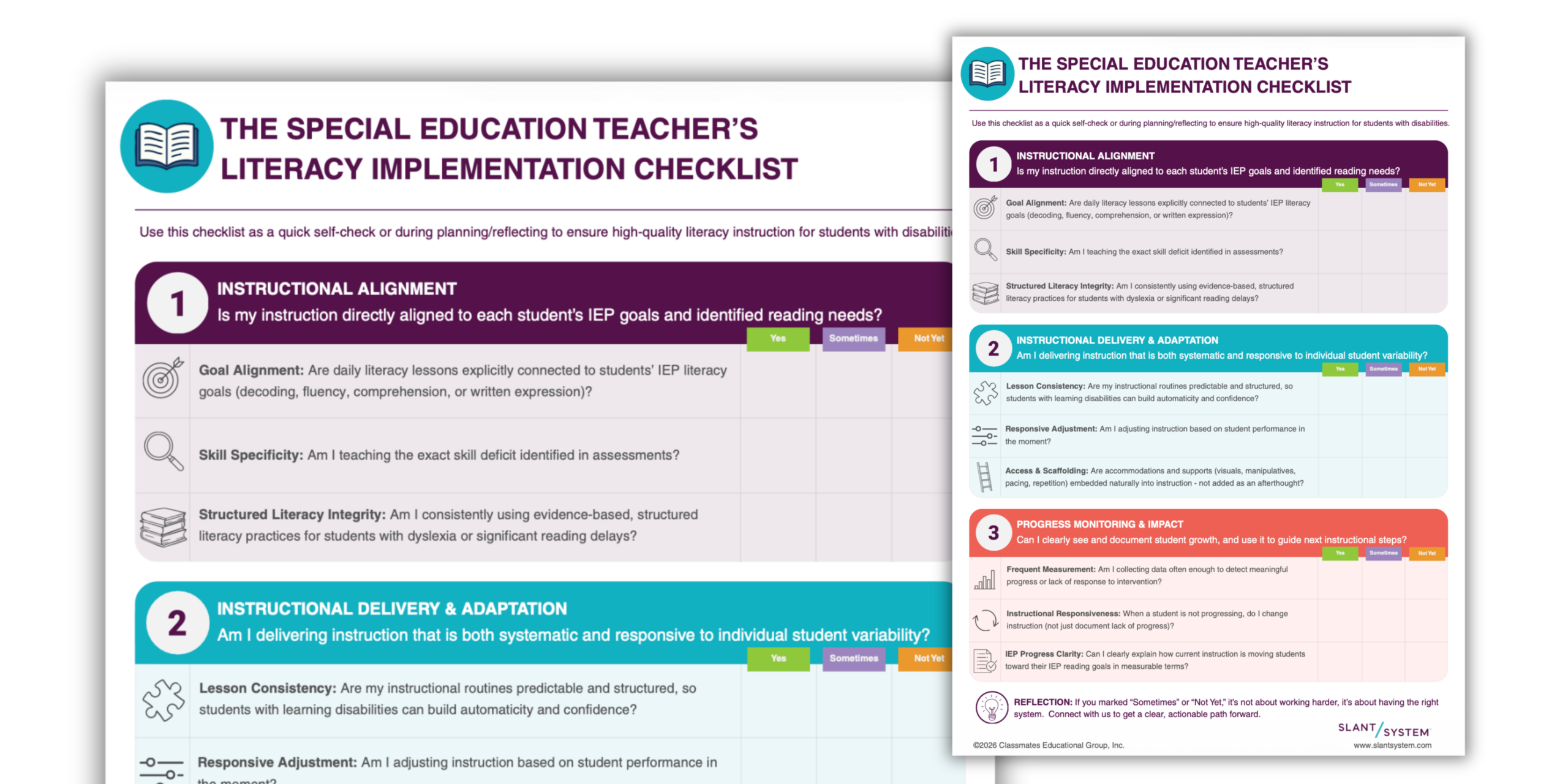
Those three questions became my compass. They’re also the foundation of this Special Education Teacher’s Literacy Implementation Checklist.

1. Is My Instruction Aligned to What This Student Actually Needs?
One of the biggest challenges in special education is the sheer number of priorities competing for our attention.
Between IEP goals, curriculum pacing, intervention schedules, meetings, progress reports, and classroom responsibilities, it’s easy to lose sight of the most important question:
Is today’s lesson directly connected to this student’s identified reading need?
As a teacher, I learned that every literacy lesson should have a clear purpose.
That means asking:
- Am I teaching the skill identified through assessment?
- Does today’s instruction connect directly to the student’s IEP literacy goals?
- Am I using evidence-based structured literacy practices when students need them?
When those answers are yes, instruction becomes far more intentional, and far more impactful.
2. Am I Teaching in a Way That Gives Students the Best Chance to Learn?
Having the right lesson is only half the equation.
How we teach matters just as much.
Students with disabilities thrive when instruction is predictable, explicit, and responsive. They need routines that reduce cognitive load so they can focus on learning, not figuring out what’s expected.
Some of the most powerful instructional shifts aren’t complicated.
They’re asking yourself:
- Are my instructional routines consistent?
- Am I adjusting instruction based on student responses in real time?
- Are supports like visuals, repetition, pacing, and scaffolds built into the lesson, not added only after a student struggles?
The best accommodations don’t feel like add-ons.
They’re simply good teaching.
3. Is My Data Helping Me Make Better Decisions?
I’ll admit it.
There were years when I collected mountains of progress-monitoring data.
The graphs looked impressive.
The binders were full.
But if I’m honest, I wasn’t always using the information to change instruction.
Data isn’t valuable because we collected it.
It’s valuable because it tells us what to do next.
Every progress-monitoring cycle should answer questions like:
- Is this student making meaningful progress?
- If not, what will I change tomorrow?
- Can I clearly explain how today’s instruction is helping the student reach their IEP goals?
That’s when data becomes a tool for teaching, not just compliance.
Reflection Is a Professional Practice, Not a Judgment
One thing I wish someone had told me earlier in my career is this:
You don’t have to score “Yes” on every item.
If you find yourself checking “Sometimes” or “Not Yet,” it doesn’t mean you’re failing your students.
It means you’ve identified an opportunity to strengthen your instructional system.
Great teachers aren’t the ones who never need to adjust.
They’re the ones who continually reflect, refine, and improve.
A Simple Checklist That Can Strengthen Your Practice
As special educators, we juggle countless responsibilities every day. Having a simple framework for reflection helps ensure that our time and energy stay focused on what matters most: helping students become confident, capable readers.
This literacy implementation checklist isn’t another document to complete.
It’s a conversation starter, a planning guide, a coaching tool, and perhaps most importantly, a reminder that effective literacy instruction doesn’t come from working harder. It comes from building systems that help every student succeed.
As you prepare for the new school year, take a few minutes to work through the checklist. You may find that a handful of small adjustments create meaningful improvements, not just for your students’ reading outcomes, but for your own confidence as an educator.
Because after spending years in a special education classroom, I’ve learned that the most effective teachers aren’t the ones doing everything.
They’re the ones doing the right things, every single day.