How to Correct b/d Reversals: A Simple Strategy That Works
How to Correct b/d Reversals: A Simple Strategy That Works
Have you ever wondered why some students confuse the letters b and d? Letter reversals are the most common myth in understanding dyslexia. These reversals are actually common among emergent readers as they learn to recognize letters and connect them to their sounds. However, when difficulties persist, they may be a red flag that a student needs additional support with foundational literacy skills.
Why Do Students Reverse b and d?
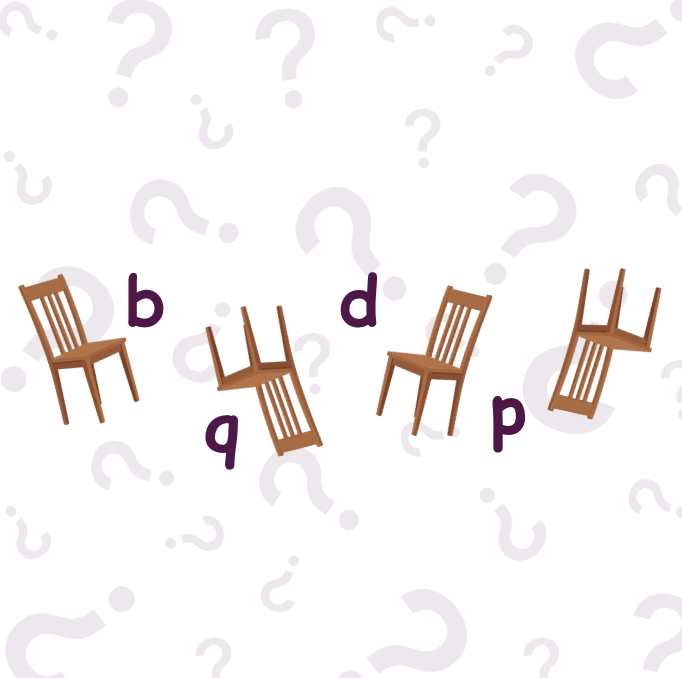
Our brains are naturally wired for mirror invariance. This means we recognize an object as the same object regardless of its orientation. Think about a chair. Whether we see it from the front, the side, or another angle, we still recognize it as a chair.

This ability is helpful when recognizing objects, but reading requires something different. Letters such as b, d, p, and q share similar shapes, yet their orientation changes their identity and sound. Students must learn to pay attention to these differences and connect each letter to the correct sound.
Letter reversals are not simply a matter of seeing letters backward. For some students, the difficulty involves learning to distinguish letter orientation and consistently connect the written symbol to its corresponding sound. Persistent reversals alone do not mean a student has dyslexia, but they can signal a need to look more closely at the student’s overall reading development.
Teach b and d With a Consistent Routine
One of the most effective ways to support students is to explicitly teach letter formation and connect each movement to a meaningful visual and sound. Our free Bat and Donut poster provides a simple, memorable way to do this.
For the letter b:
- Bat: Start at the top and move down.
- Up and around: Move back up and around to form the letter.
- Say the sound: /b/
Use the consistent verbal cue: “Bat down, up and around, /b/.”

For the letter d:
- Donut: Start with the round part and form the circle.
- Up, down: Move up and then down to complete the letter.
- Say the sound: /d/
Use the consistent verbal cue: “Donut, up, down, /d/.”
Have students practice these movements repeatedly while saying the cue and sound. If a student forms a letter incorrectly, guide them back to the correct starting point and have them try again. The goal is to build accurate, automatic letter formation and sound-symbol connections.
Connect the Letter to the Sound During Reading
The learning should not stop at handwriting. Students also need to retrieve the correct sound when they encounter the letter in print.
When a student comes to a b or d and hesitates or makes an error, prompt them to walk up to the letter with their fingers.
For b, ask:
- “What did you touch first?”
- “The bat!”
- “What sound does bat start with?”
- “/b/!”
For d, ask:
- “What did you touch first?”
- “The donut!”
- “What sound does donut start with?”
- “/d/!”
Then have the student read the word again. With consistent practice, students learn to use the letter’s formation as a cue for retrieving its sound.
Practice Makes Progress
Correcting b/d reversals requires explicit instruction, consistent language, and plenty of opportunities to practice. Teach the formation, connect it to the sound, and reinforce the same routine during reading and writing. To be most effective, we HIGHLY recommend that this same strategy and language is used throughout a school to help ALL students in the most consistent way.
If reversals persist despite appropriate instruction, consider the student’s broader phonemic awareness, letter-sound knowledge, decoding, spelling, and reading progress. These skills provide a more complete picture of whether additional assessment or targeted intervention is needed.
Download our FREE b/d strategy poster to help students remember how to form b and d and connect each letter to its sound. A simple, consistent routine can make a meaningful difference as students build strong foundational reading skills.