1 mat, 2 Ways: How to use Elkonin boxes for Reading Success
1 mat, 2 Ways: How to use Elkonin boxes for Reading Success
Whether you’re building foundational listening skills or bridging the gap to phonics, Pound and Sound mats (Elkonin boxes) are one of the most effective, multimodal tools in a structured literacy toolkit.
Here is how you can use these exact mats in two distinct ways to boost reading instruction.
Way 1: Pure Phonemic Awareness (Listening & Moving)
No letters needed…yet! This approach focuses purely on hearing and manipulating individual sounds (phonemes) in spoken words.
For students with dyslexia, working with sounds orally before introducing written letters can be a helpful scaffold. Dyslexia often involves difficulties with phonological processing, or recognizing and working with the sounds in spoken words. Beginning with sounds can reduce the cognitive demands of managing both sounds and unfamiliar letter correspondences at the same time. This allows students to focus on identifying, distinguishing, and manipulating sounds, including those represented by letter patterns they have not yet learned. Research supports explicit phonemic awareness instruction as an important foundation for reading, while emphasizing the importance of connecting speech sounds to their written representations as instruction progresses (Ehri et al., 2001; Moats, 1998).

How it works:
- Say the Word: Say a word aloud (e.g., “cat”).
- Map the Sounds: Ask the student to stretch out the word and push a manipulative (Goldfish crackers, bingo chips, pennies, small pom-poms, or candy corn) into one box for every sound they hear.
- Example: /k/ (push into Box 1), /a/ (push into Box 2), /t/ (push into Box 3).
- Blend it: Have the student slide their finger along the arrow from left to right to blend the sounds back together and say the whole word.
Way 2: Phonics & Print (Print & Laminate for Writing)
Once students can identify and segment the individual sounds in spoken words, the next step is to connect those sounds to their written representations.
This is the foundation of the alphabetic principle: letters and letter combinations represent the sounds in spoken words. When students segment a word and write the corresponding grapheme for each phoneme, they strengthen the connections between speech sounds and print. These connections support both decoding and spelling and help students build increasingly automatic word recognition (Ehri et al., 2001; Moats, 2020).
Preparation:
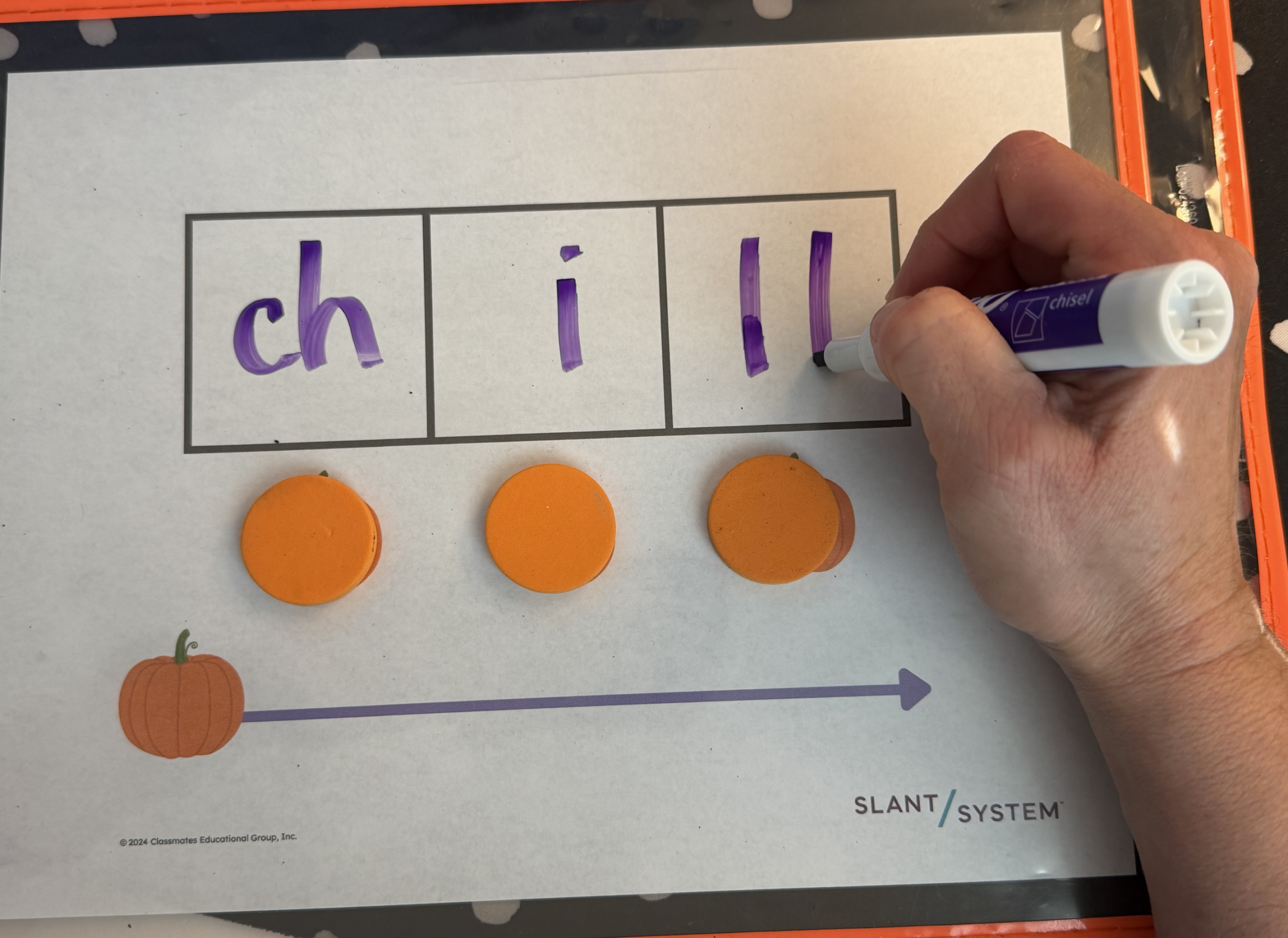
- Print and Laminate: Print out the 3-, 4-, and 5-box mats and laminate them (or pop them into reusable dry-erase pockets).
How it works:
- Pound & Sound: Say a word aloud (e.g., “frog” on a 4-box mat). The student pounds the word and taps each box as they segment the sounds (/f/ – /r/ – /ŏ/ – /g/).
- Write the Letters: Using a dry-erase marker, the student writes the corresponding letter(s) for each sound directly inside the laminate boxes while simultaneously saying the sounds out loud:
- Box 1:
f - Box 2:
r - Box 3:
o - Box 4:
g
- Box 1:
- Read & Wipe: The student slides their finger along the arrow underneath to read the word, then wipes the mat clean for the next word!

Pro Tip for Teachers, Parents, & Tutors
- Keep Digraphs Together: Remind students that two letters making one sound (like
sh,ch, orth) share one single box. - Differentiate Easily: Use the 3-box mat for CVC words including single consonants and digraphs (cat, dog, ship, math), the 4-box mat for words with consonant blends (frog, slip, past, stop), and the 5-box mat for longer words (plant, stamp, splat, shrimp).

References:
Ehri, L. C., Nunes, S. R., Willows, D. M., Schuster, B. V., Yaghoub-Zadeh, Z., & Shanahan, T. (2001). Phonemic awareness instruction helps children learn to read: Evidence from the National Reading Panel’s meta-analysis. Reading Research Quarterly, 36(3), 250–287. Read the abstract
Moats, L. C. (1998). Teaching decoding. American Educator, 22(1–2), 1–9. Read the article
Moats, L. C. (2020). Teaching reading is rocket science: What expert teachers of reading should know and be able to do. American Educator, 44(2), 4–9, 39. Read the article