Alphabet Knowledge: Simple, Powerful Strategies to Build Early Literacy
By Karla O’Brien and Beth Hatlen
“After 16 years in a kindergarten classroom, I can confidently say that teaching early literacy is one of my greatest joys. I still smile thinking about how many students believed ‘el-uh-men-oh-p’ was a single letter! (Say it fast, you know the one.)
Though I’m no longer teaching kindergarten every day, I was recently reminded of the magic of those early years while watching the dynamic Jake Dagget present at the SOR Mini-Con hosted by Heidi Martin. His energy highlighted a critical truth: young children learn best through movement, rhythm, and interaction.
As Dr. Anita Archer says, ‘Learning is not a spectator sport.’”
— Beth Hatlen
Why Alphabet Knowledge Matters
Alphabet knowledge is more than just singing the ABCs. It involves the ability to recognize and name both uppercase and lowercase letters, connect those letters to their corresponding sounds, and begin forming them correctly in writing. Research consistently shows that strong alphabet knowledge is one of the top predictors of future reading and spelling success, especially when it is paired with explicit, systematic instruction aligned to the science of reading and Orton-Gillingham principles.
According to an article in The Reading League Journal from earlier this year, “Brick by Brick: Insights on Alphabet Instruction From Research” by Alisha Nicole Demchak and Emily Solari, alphabet knowledge is a foundational step toward literacy, not the end goal. Research shows that explicit, well-sequenced instruction linking letter names and sounds, paired with consistent practice, best supports future reading and writing success.
Easy Alphabet Activities for Home and School
Here are simple, engaging ways to build alphabet skills through daily routines and playful interactions:
Magnetic Letter Play
Use magnetic letters on the fridge or a cookie sheet. Try:
-
Sorting by color or shape
-
Matching upper- and lowercase letters
-
Grouping letters by beginning sound
Tip: These lowercase letters by Hand2Mind are a great tool!
Name It and Say It
Say the letter and its sound together: “That’s the letter M. M says /m/ like mop.” Leap Frog makes great alphabet learning toys!
Read Alphabet Books
Choose books that emphasize letter-sound relationships. Some classroom and parent favorites:
-
Chicka Chicka Boom Boom by Bill Martin Jr. & John Archambault
-
Dr. Seuss’s ABC by Dr. Seuss
-
Z is for Moose by Kelly Bingham
-
The Alphabet Book by P.D. Eastman
Use Visual Anchors
Display an alphabet chart with letter names, sounds, and keyword images (e.g., M /m/ mop).
👉 [Download your free alphabet chart here.]
Handwriting with Purpose
As children write letters, link them to sounds by saying, “We’re writing the letter that spells /b/.” Encourage kids to make the letter’s sound out loud as they write it – “/b/….b” – this simultaneous saying and writing helps strengthen their connection between letters and sounds. Tracing is a great place to start, and you can make it extra fun by tracing letters in shaving cream spread on a tray, in sand, or with finger paint!
Sound Sorts
Sort pictures or small objects by beginning sound (e.g., /s/ vs. /m/).
Alphabet Arc Practice
 Use an alphabet arc to support sequencing, sound recognition, and memory. This hands-on tool reinforces the alphabetic principle, a key component of reading readiness.
👉 [Learn more and download your free Alphabet Arc here.]
Tools That Support Alphabet Learning
To make alphabet teaching even easier, we developed Alphabet Learning and Tracing Cards. These are perfect for small groups, centers, interventions, and at-home practice.
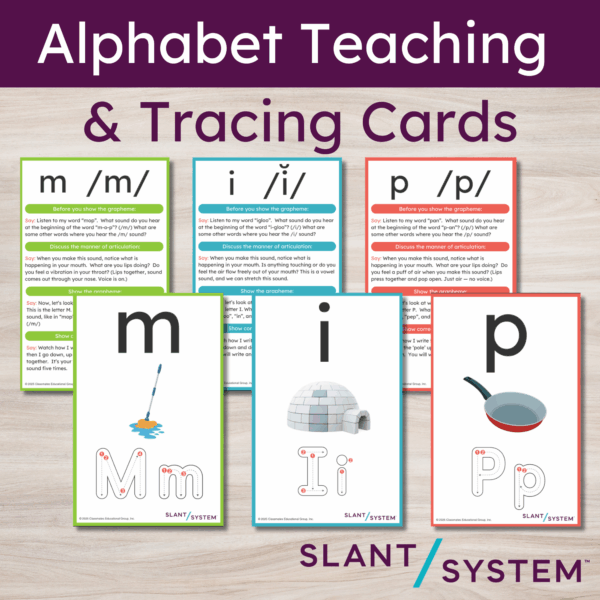
Each card includes:
-
Uppercase and lowercase letter models
-
A keyword picture with sound prompt
-
Letter formation strokes for handwriting
-
A simple teaching script for consistent, effective instruction
These cards align beautifully with structured literacy practices grounded in the science of reading.
Build the Foundation. Build a Reader.
Alphabet instruction doesn’t require a complex curriculum. It requires consistency, intentionality, and joy. Whether you’re supporting a preschooler, kindergartner, or older struggling reader, building alphabet knowledge is the first step toward decoding, spelling, and comprehension.
When children connect letters to sounds, understand how letters form words, and feel confident writing them, they’re not just learning letters. They’re learning how to read.
If you’re looking for structured, research-based training on how to teach alphabet knowledge and early literacy skills, the Slant System™ offers practical tools and proven strategies grounded in the science of reading.👉 Join our next training cohort or explore our resources to start building confident readers.
References:
Demchak, A. N., & Solari, E. (2025, January–February). Brick by brick: Insights on alphabet instruction from research. The Reading League Journal, pp. 22-26.