Understanding the Slant System™ Teaching Sequence for Stages 1-7
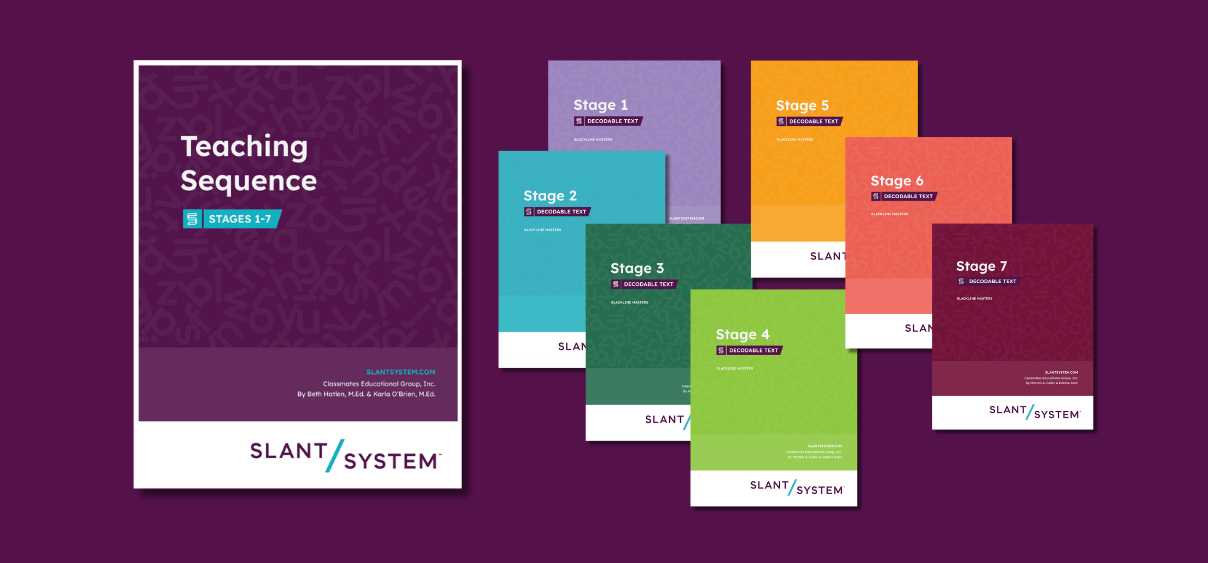
The Teaching Sequence is a hallmark of the Slant System™, setting it apart from other structured literacy programs. Drawing on the principles of the Orton-Gillingham method, this sequence comprises seven carefully designed stages, each serving as a foundational building block for the next. The skills introduced in each stage are cumulative and increasingly complex, ensuring systematic and effective literacy instruction, especially critical for struggling readers and those with dyslexia. 
Overview of the Slant System™ Teaching Sequence
Stages 1 and 2: Mastery of Short Vowels and Closed Syllables
Stages 1 and 2 focus on short vowels, single consonants, consonant blends, digraphs, and the most common suffixes. These stages also introduce students to the closed syllable type and the VC/CV syllable division pattern. The closed syllable accounts for nearly 50% of syllables in running text, making it a critical foundation for reading and spelling. By devoting two stages to these concepts, students develop a strong grasp of short vowel sounds and closed syllables, ensuring they are ready to progress to more complex patterns.
Stage 3: Long Vowel Sounds and New Syllable Types
In Stage 3, students transition to long vowel sounds and are introduced to two new syllable types: the open syllable and the silent ‘e’ syllable. They also learn additional syllable division patterns, including V/CV, VC/V, VCC/CV, and VC/CCV, along with the vowel “y” as a vowel sound. This stage expands students’ understanding of English syllable structures, enabling them to decode and spell more advanced words with confidence.
Stage 4: Vowel Teams and R-Controlled Vowels
Stage 4 introduces vowel team/digraph syllables, the final method for creating long vowel sounds, and R-controlled vowel syllables. These concepts further enrich students’ knowledge of syllable types. Instruction also incorporates homophones and contractions, challenging students to deepen their comprehension of language nuances while strengthening their written communication skills.
Stages 5, 6, and 7: Morphology and Advanced Syllable Types
In Stages 5 and 6, the focus shifts to diphthongs, or sliding vowels, and the morphological components of words. In Stages 5 and 6, students explore common affixes and learn essential spelling rules for adding suffixes. These stages emphasize the structure and meaning of words, preparing students to decode and spell multisyllabic words effectively. By mastering these advanced concepts, students gain the tools to handle increasingly complex text with accuracy and understanding.
In Stage 7, the final syllable type, consonant-le, is introduced along with less common spelling patterns. This stage places a strong emphasis on morphology, equipping students with the tools to analyze and understand the meaning and structure of advanced words. By mastering the content of these stages, students are empowered to tackle increasingly complex text with accuracy and understanding.
The Intentional Progression of the Slant System™
Each stage of the Slant System™ Teaching Sequence is intentionally structured, with letter-sound correspondences sequenced from more frequent and simpler patterns to more complex ones. This thoughtful design ensures that students gain a deep understanding of the English language, empowering them to read and spell with accuracy and confidence.
Establishing the Best Starting Point
The Slant System™ is designed to build a strong foundation in letter-sound relationships and essential language concepts. For younger students or those new to structured literacy, it is highly recommended to begin at Stage 1 to ensure mastery of foundational skills before progressing. For older students who already demonstrate accurate word reading at or above a second-grade level but struggle with spelling or have gaps in specific areas, the starting point may be adjusted. These students may begin with a review of particular language concepts or sound-letter relationships they need, with targeted support using tools like nonsense word lists to reinforce and solidify their understanding. To determine the best starting point for each student, the use of the Slant Phonics Survey is strongly encouraged.
Download the Slant System™ Teaching Sequence here!
Ready to Take the Next Step?
Are you ready to empower your students with a proven and systematic approach to literacy? The Slant System™ provides educators with the tools and training to make a lasting impact on reading and spelling proficiency. Download our comprehensive teaching sequence and explore our decodable texts aligned to the Slant System™ Scope and Sequence to bring structured literacy to life in your classroom.
Join the thousands of educators who have transformed their classrooms through Slant System training. Visit our website to learn more about our professional development opportunities, access free resources, and start your journey with the Slant System™ today!