Crossing The Bridge of Reading Fluency
When I think back to my earliest years of teaching, I can still remember the message I heard over and over again:
“Oral reading fluency is tied to reading comprehension.”
I interpreted that very literally. To me, that meant:
-
fast readers = better comprehension
-
slow readers = comprehension struggles
So I drew the conclusion that many new teachers quietly make:
If I could just get my students to read faster, their comprehension would improve.
For years (more years than I’d like to admit) I focused heavily on rate. Timed readings. Repeated readings. Encouraging kids to “beat their score.” Sometimes I even equated improvement with “more words per minute,” not realizing how narrow that lens truly was.
And here’s the part that makes me cringe now:
Some of my students did read faster.
But they didn’t understand more.
In fact, sometimes they understood less.
It wasn’t until much later, during my structured literacy practicum, that everything shifted. I learned about Scarborough’s Reading Rope, the Simple View of Reading, and the actual complexity of reading fluency. Not speed. Not racing a timer. Not robotic reading that checks a box but misses the point.
I realized fluency was the outward expression of many inward processes, including decoding, language, vocabulary, background knowledge, syntax, cognitive load, attention, confidence, and so much more.
And most importantly, I learned this:
If we don’t pinpoint the exact area holding a child back, then we are not truly helping them.
A child’s slow rate isn’t always a rate problem.
A child’s choppy reading isn’t always a fluency problem.
A child’s monotone voice isn’t always a prosody problem.
Reading is an extremely complex process, a beautifully coordinated mental symphony. Dozens of cognitive skills must stay in sync, and when even one is out of tune, fluency falters. Fluency isn’t one skill; it’s a reflection of many skills working together.
And this is exactly why The Bridge of Reading Fluency graphic was created:
to help educators, like myself, conceptualize every major factor that contributes to fluency so we can accurately identify what each child truly needs.
How the Research Shifted the Way We See Fluency
As I dug deeper into structured literacy, the research began to paint a very different picture of fluency than the one I had held early in my teaching career. It didn’t come from one expert or one framework, it emerged like a clear melody as all the voices aligned.
Jan Hasbrouck’s work helped me understand that fluency was far more than speed; it was the seamless coordination of accuracy, automaticity, and expression, all working together to support comprehension. Around the same time, Tim Rasinski’s research added another layer, showing that fluency is also deeply tied to phrasing and prosody. He demonstrated that how students read, their tone, their pauses, their rhythm, reveals how well they understand.
Then Linnea Ehri’s work brought the word recognition side of fluency into focus. Her research on orthographic mapping showed how students gradually shift from slow, effortful decoding to reading words so quickly and effortlessly that both their pronunciation and meaning activate in an instant. Suddenly, I could see how automatic word recognition frees up cognitive space for expressive, meaningful reading.
And guiding it all was Scarborough’s Reading Rope and the Simple View of Reading. These models wove the big picture together: word recognition × language comprehension = reading comprehension.
A weakness in either domain pulls everything else down, including fluency.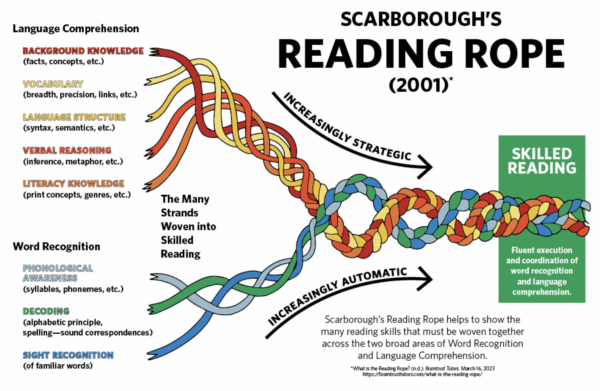
What struck me most was this:
Every strand of the rope contributes to fluency, and fluency in turn reflects the strength of those strands. If decoding is shaky, fluency suffers. If language comprehension is fragile, fluency suffers. If background knowledge or vocabulary is thin, fluency suffers. If syntax is confusing or working memory is overwhelmed, yes, you guessed it, fluency suffers.
The Bridge of Reading Fluency graphic sits right inside this body of research. The bridge doesn’t simplify reading; it reveals its complexity in a way teachers can actually use.
It’s our reminder that:
If we don’t pinpoint which part of the bridge is weak, we can’t strengthen a child’s fluency.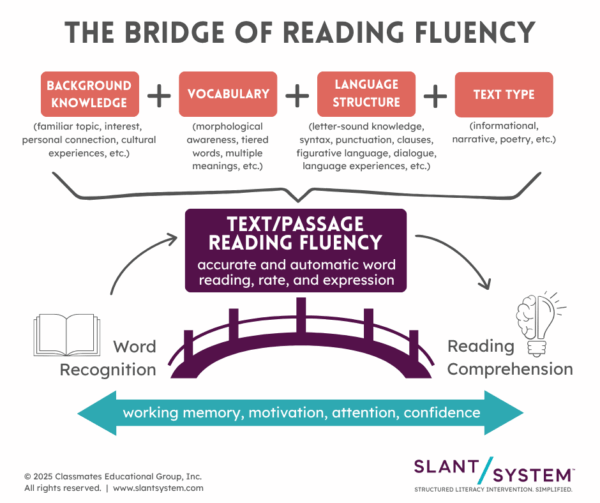
DOWNLOAD THE BRIDGE OF READING FLUENCY GRAPHIC!
Explaining the Bridge: What Text/Passage Fluency Really Is
Text or passage reading fluency is the bridge between accurate, automatic word recognition and meaningful reading comprehension. Without that bridge, readers either get stuck on the decoding side, laboriously working through words, or they leap too quickly toward comprehension without truly understanding the text on the page.
Fluency is not a single skill. It’s a constellation of processes that must come together to produce reading that is smooth, expressive, appropriately paced, and rooted in meaning. And when even one of those processes is weak, the entire bridge begins to wobble.
The Bridge of Reading Fluency graphic captures this truth by highlighting four critical components that shape how fluently a student can read: background knowledge, vocabulary, English language structure, and text type. Each one plays a unique and essential role.
Let’s explore each, with examples that bring them to life.
1. Background Knowledge: The Fuel for Fluent Reading
Researchers have long shown that what a reader already knows about a topic profoundly affects how easily they can read and understand a passage. Background knowledge activates predictions, supports vocabulary, and allows the reader to process text more efficiently.
When background knowledge is missing, reading slows, not because decoding is weak, but because the reader is constantly trying to make sense of unfamiliar concepts.
Example:
“The cryosphere’s rapid melt has disrupted thermohaline circulation, reshaping global climate patterns.”
Most students can decode every word, but they read slowly or hesitantly because the concepts are unfamiliar.
Compare that to:
“The puppy eagerly chased the bouncing ball across the yard.”
Even a struggling reader often reads this more fluently because the world of puppies and balls is familiar and meaningful.
Research consistently shows that background knowledge is one of the strongest predictors of comprehension (Willingham, 2006; Cervetti & Wright, 2020). When knowledge is strong, fluency improves because the brain isn’t fighting to make sense of the content.
2. Vocabulary: More Than Knowing Words—Knowing How They Work
Vocabulary is a powerful thread in the reading rope. A reader with a robust lexicon, and an understanding of how words relate to one another, can read with confidence, rhythm, and expression.
But vocabulary is not only about knowing definitions. Students also need:
-
morphological knowledge
-
multiple-meaning awareness
-
academic language understanding
-
culturally and linguistically responsive instruction (especially for ELLs)
Example:
The word draft can mean cool air, a version of writing, a sports selection process, or being pulled. Without flexible vocabulary knowledge, fluency stalls, not because decoding is weak, but because meaning is unclear.
Vocabulary knowledge is deeply tied to comprehension (Beck, McKeown & Kucan, 2013). Without meaning, prosody collapses. Students cannot phrase confidently if they don’t understand the words they’re saying.
3. English Language Structure: The Architecture of Fluent Reading
This component includes everything related to how sentences are built: syntax, punctuation, clauses, figurative language, and more. Readers must understand how words fit together so they know where to pause, what to emphasize, and how to group phrases.
Example:
“When the bell rang, signaling the end of class, the students—who had been waiting impatiently—bolted for the door.”
A syntactically aware reader naturally phrases this into chunks; a reader unfamiliar with sentence structure reads word-by-word, flattening the meaning. Same words, completely different experience.
Rasinski’s research shows that phrasing and prosody, the “music” of reading, are inseparable from syntactic awareness. Fluent readers hear the structure of language; struggling readers often do not.
4. Text Type: Genre Shapes How We Read
Fluent readers adjust their pace, tone, and expression based on the text:
-
Narrative: characters, emotion, dialogue
-
Informational: clarity, precision, emphasis
-
Poetry: rhythm, imagery, interpretation
-
Procedural: sequence and clarity
Example:
Narrative: “‘Don’t go in there,’ she whispered, her voice trembling.”
Informational: “The heart pumps oxygenated blood through a network of arteries and capillaries.”
Reading these in the same tone signals a fluency breakdown, not in decoding, but in genre awareness.
Scarborough’s Rope identifies “literacy knowledge”, genre and structure, as essential to comprehension, and therefore to fluency.
How Working Memory, Motivation, Attention, and Confidence Shape Fluency
Even when the four pillars are strong, fluency can falter if cognitive resources are overloaded. Working memory must hold words and ideas long enough to make meaning. Attention keeps reading steady and focused. Motivation determines whether a student engages deeply enough to reread, practice, or persist through complex text. Confidence shapes willingness to read aloud, try expressive phrasing, or take risks.
A child who is anxious, distracted, or mentally overloaded may appear “not fluent,” when in reality their cognitive system, not their reading skill, is struggling. When these factors are supported, fluency emerges more naturally and authentically.
Bringing It All Back: The Cognitive Symphony at Work
When you step back from the graphic, you realize that text fluency is not a linear skill—it’s a cognitive symphony:
-
Background knowledge sets the stage.
-
Vocabulary brings the meaning.
-
Language structure conducts the phrasing.
-
Text type shapes the performance.
-
Word recognition keeps the piece moving.
-
Working memory, attention, motivation, and confidence keep the music from falling apart.
Fluent reading is what happens when all of these mental instruments play in harmony. If even one is out of tune, fluency falters.
That’s why we must look beyond rate, beyond accuracy, beyond the stopwatch, and identify which part of the symphony needs tuning for each child. When we strengthen the right part of the bridge, fluency, comprehension, and confidence begin to flow.
A Final Note: How This Connects to the Slant System™
This is precisely why the Slant System™ places such a strong emphasis on fluency, not as speed, not as performance, but as the natural outcome of well-supported structured literacy instruction. In the Slant System™, students build accuracy and automaticity through explicit instruction, strengthen vocabulary and language through meaningful practice, and develop fluency through routines that honor phrasing, prosody, and comprehension. When teachers understand the full bridge, and teach each component with intention, students don’t just read faster, they read with understanding, confidence, and joy.
Want to see how the Slant System™ explicitly teaches the skills that build fluency?
Join us for our next training and take the guesswork out of fluency instruction.
DOWNLOAD THE BRIDGE OF READING FLUENCY GRAPHIC!
by Karla O’Brien, M.Ed., LBS1, C-SLDI