A Dedicated Special Educator Transforming Adult Literacy with Slant System™ Structured Literacy: An Interview with Mary Berman
Mary Berman is a passionate special educator who works with adults ages 18 to 50+ with intellectual disabilities. Her students have diverse learning needs, including dyslexia, autism, learning disabilities, and visual, hearing, or physical impairments.
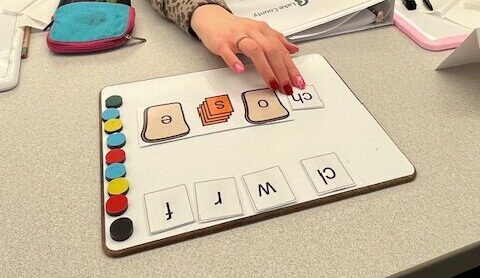
Even in “retirement,” Mary remains deeply committed to education. She has developed multiple courses for the Lancer Explore Institute, part of the College of Lake County, to support adult learners on their literacy journey. Recognizing the importance of structured literacy, Mary created courses at multiple levels using the Slant System, a structured literacy approach rooted in Orton-Gillingham principles.
With over 25 years of experience, Mary has also served as a vocational coordinator in Lake County, IL. Her journey with the Slant System began in 2006 when she was trained by its original creator, Marsha Geller. Together, they worked to adapt the system to better serve Mary’s students while preserving the fidelity and integrity of lesson delivery.
Mary’s unwavering dedication ensures that every student, regardless of their challenges, has the opportunity to develop essential literacy skills and thrive.
An interview with Beth Hatlen and Mary Berman:
BH: What inspired you to teach adult learners how to read?
MB: I was a vocational coordinator and I was seeing very capable students struggling on the job because of poor reading skills. I was told, if they hadn’t learned by now they never would. This made no sense to me. Here I was in my 50’s going for a second master’s degree. If I could learn new things, why couldn’t my students?!
BH: What are some of the challenges your students face in learning to read as adults?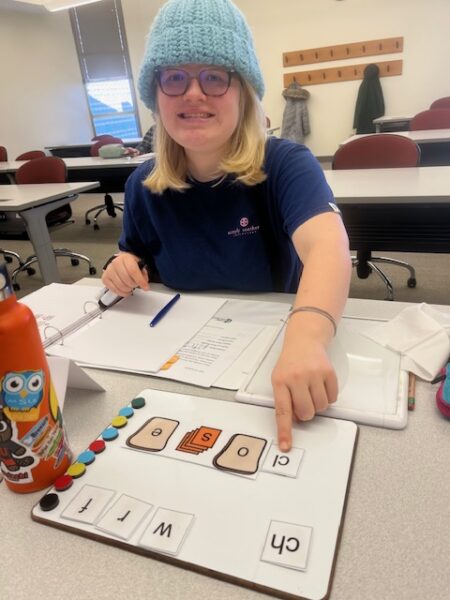
MB: Many years of negative experiences. They think they cannot do it. They have picked up bad habits from years of ineffective training. Also, people assume all adults can read. When you’re a kid, people are glad to help you. Try navigating the world as an adult when you read on the 2nd grade level – it’s a daunting task!
BH: Can you share a success story of a student who has benefited from your instruction?
MB: I had a student who came to me at 3rd grade reading level. After four classes with me she had improved her reading to the 6th grade level. She was able to pass the college entrance tests and was accepted into the culinary program. She was even on the honor roll!
Another student started at 6th grade and was at 10th grade after four Slant classes. She went on to Shepherds College in Wisconsin (for special needs students) and did so well there that she has been hired as a staff member.
BH: What strategies or techniques from the Slant System™ have been most effective?
MB: The emphasis on multimodal instruction; use of visual, kinesthetic and mnemonic devices. The whole approach gives [my students] the message that they can do it!
BH: How do your students respond to the structured approach of the Slant System™?
MB: They really benefit from and appreciate the consistent structure of the Slant lessons. They like knowing what comes next and how the stories tie in with the sound/concept being taught [connected text].
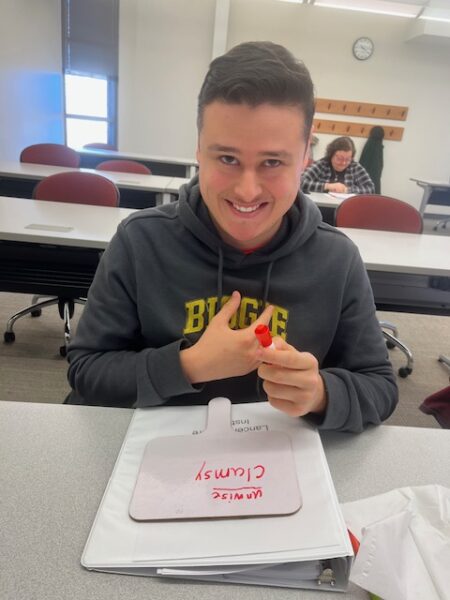 BH: What impact has improved literacy had on your students’ personal or professional lives?
MB: My students requested a book club. We meet at a local cafe monthly to have lunch and discuss the books. Several students have really become readers for pleasure. An example is one who enjoys reading one of my favorites, Janet Evanovich’s Stephanie Plum series. She competes with me to see who can read the latest book first and we have great fun discussing the characters.
BH: How has using the Slant System™ influenced your perspective on teaching literacy?
MB: It has raised my standards and when students are unable to read I see it as a weakness in the teaching, not a deficit in the students. I see the teaching of literacy as a constantly evolving process [that must be] based upon ongoing research. As we know more, we do better. The students are constantly learning, and so am I. I wish there were more teachers using structured literacy training with adults who have intellectual disabilities and autism.